
In an era of mass-produced food and fast-paced dining, the “Mill to Meal” concept stands out as a powerful antidote. It invites visitors not merely to eat, but to become active participants in the entire journey of their meal — from raw grain to fragrant, golden delicacy.
By processing ingredients using ancient tools and time-honored techniques, guests gain a profound appreciation for freshness, sustainability, and the living heritage of local food knowledge.
Nowhere is this more vividly experienced than at Khasrang Village, where the simple act of pounding rice transforms into an unforgettable cultural and sensory adventure.
The Khasrang Village Experience: Pounding Rice to Making Selroti
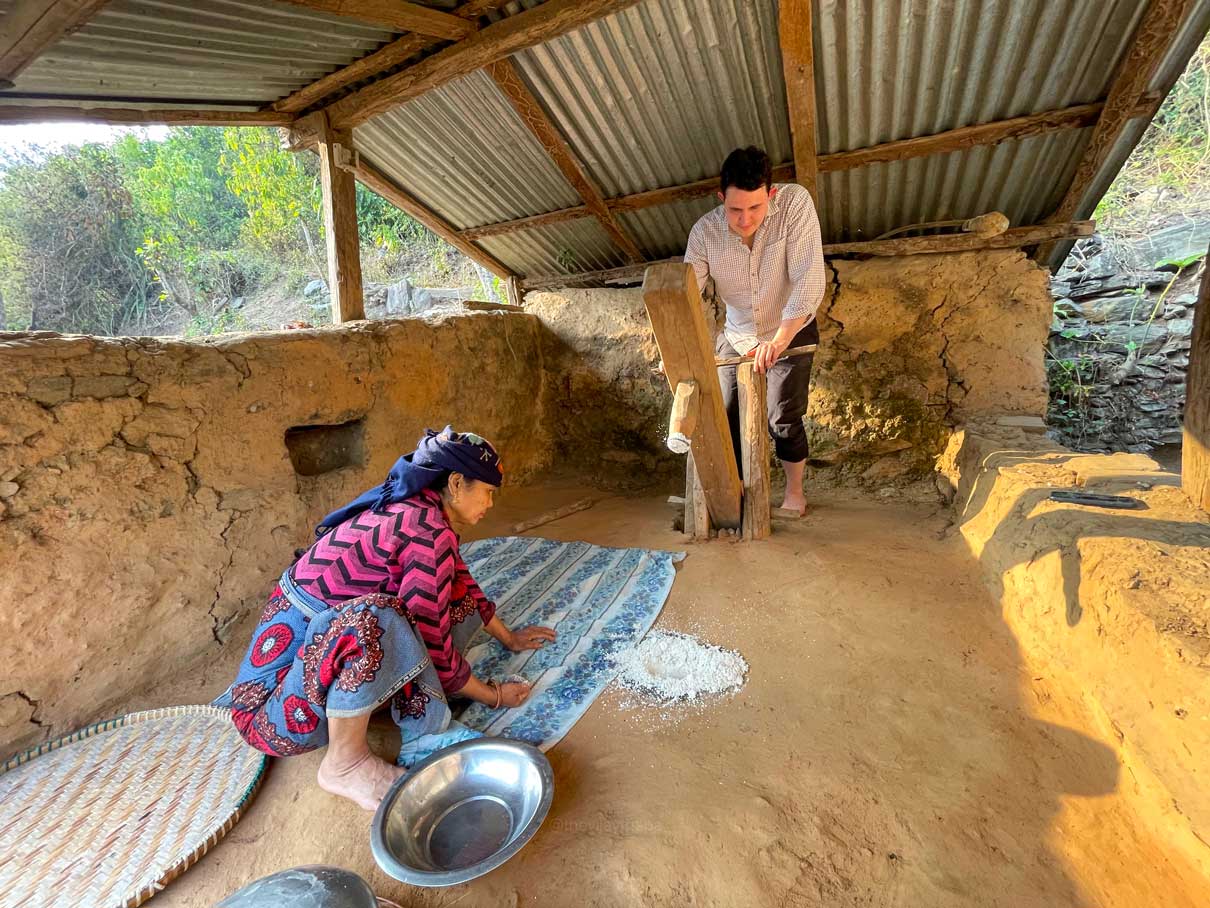
At Khasrang Village, the Mill to Meal experience begins with the rhythmic thud of the traditional wooden mill known as Dheki.
Unlike modern electric mills that instantly grind rice into flour, the Dheki works grain by grain. Visitors join local hosts in rhythmically pounding the rice, pausing frequently to check progress.
The partially crushed grains are then poured onto a large bamboo winnowing tray called Nanglo. With skilled hand movements that create vibration and rely on gravity, the refined flour is gently separated from the unbroken grains.
The coarser pieces go back into the Dheki for another round of pounding — a patient, meditative process that demands attention, timing, and coordination.
Once the fresh flour is ready, the real magic unfolds. The flour is mixed by hand with water, ghee, and sugar to create a silky batter.
Then comes the most joyful part: shaping Nepal’s beloved national delicacy, Selroti. Standing around a hot cauldron of oil, visitors carefully pour the batter in a steady circular motion to form perfect ring-shaped breads. The rings sizzle, turn golden, and are lifted out crisp and aromatic — ready to be enjoyed immediately.
Every step is guided by local elders and families who have practiced these methods for generations. The experience is not a demonstration; it is genuine participation.
Why Do These Experiences Matter Deeply to Visitors?
For travelers, Mill to Meal is far more than a cooking class — it is a transformative encounter that reconnects them with the true meaning of food.
1. Freshness and Sensory Awakening
When you pound the rice yourself, sift it with a Nanglo, and fry Selroti minutes later, you taste something profoundly different. The flour has never been stored, oxidized, or transported. The aroma, texture, and subtle sweetness of the fresh Selroti are incomparable to anything packaged. Visitors leave with heightened senses and a new standard for what “fresh” actually means.
2. Understanding Sustainability from the Ground Up
The traditional process uses zero electricity, minimal waste, and only natural materials. The Dheki and Nanglo are crafted locally, repaired by hand, and last decades. By contrast, modern milling consumes energy and often discards nutrient-rich bran. Participants witness firsthand how traditional methods are inherently sustainable, reducing their own carbon footprint through conscious choices long after the visit.
3. Education on Food Origins and Hidden Skills
Most people have never seen how rice becomes flour, let alone understood the skill required to use a Nanglo. The experience demystifies the journey from farm to plate. Visitors learn why traditional knowledge matters: the Dheki preserves more nutrients, the hand-mixing technique creates better texture, and the gravity-based sifting is both efficient and gentle. This knowledge fosters deeper respect for farmers, millers, and cooks whose labor is usually invisible.
4. Cultural Immersion and Personal Growth
Pounding rice together with locals creates laughter, stories, and genuine bonds. Many visitors describe the experience as meditative — the repetitive motion calms the mind while the shared goal builds community. Learning a skill that has sustained families for centuries gives a powerful sense of connection to something larger than oneself. For families, it becomes a meaningful activity that children remember forever.
5. Preservation Through Participation
By taking part, visitors become living stewards of tradition. They carry the memory of the Dheki’s rhythm and the warmth of fresh Selroti back home, often sharing photos, recipes, and stories that keep these practices alive in the wider world.
How Visitor Participation Directly Supports Rural Places and Traditional Knowledge?
Every guest who joins a Mill to Meal experience at Khasrang Village becomes a quiet yet powerful force for rural revival.
1. Economic Empowerment for Village Families
Tourism income flows directly into the hands of local households. Instead of depending solely on agriculture, families earn from guiding, hosting, and sharing their expertise. This extra revenue supports children’s education, improves homes, and keeps younger generations from migrating to cities. The money stays in the village rather than leaking to large corporations.
2. Keeping Traditional Knowledge Alive
When elders teach visitors how to use the Dheki and Nanglo, they are passing knowledge that might otherwise fade. Young people in the village see renewed pride in their heritage when outsiders travel far to learn it. The practices are no longer “old-fashioned” — they are valuable, sought-after skills. This intergenerational transmission ensures that the intricate techniques of rice pounding, flour refinement, and Selroti making survive for decades to come.
3. Revitalizing Rural Communities
Experiences like this create a virtuous cycle. Villages gain visibility, more visitors arrive, and locals invest in preserving their culture. Traditional tools are maintained, recipes are documented, and festivals centered around these foods gain new energy. The entire community feels valued and motivated to protect its identity.
4. Promoting Genuine Sustainability
By supporting low-impact, zero-waste methods, visitors help prove that traditional systems can thrive alongside modern life. The demand for authentic experiences encourages villages to resist replacing Dheki mills with electric ones. In this way, tourism becomes a tool for environmental conservation rather than destruction.
5. Building Global Advocates
Visitors return home as ambassadors. They tell friends about the beauty of Khasrang, the taste of fresh Selroti, and the importance of protecting rural knowledge. Social media posts, travel blogs, and dinner-table stories spread awareness far beyond Nepal, creating ongoing support for similar initiatives across the country.
A Meal That Feeds More Than the Body
The Mill to Meal experience at Khasrang Village is a perfect illustration of how thoughtful tourism can heal the disconnect between people and their food.
For visitors, it offers freshness, learning, joy, and a deeper understanding of sustainability.
For the rural communities who host it, every pounding of the Dheki and every golden ring of Selroti brings economic strength, cultural pride, and hope for the future.
In choosing to participate, travelers do more than enjoy a delicious meal — they help keep centuries-old knowledge alive, support entire villages, and remind the world that the most meaningful journeys often begin with something as simple as a handful of rice.
“If you ever find yourself in Nepal, do not just taste Selroti — help make it. The Dheki is waiting, the Nanglo is ready, and the village of Khasrang is ready to welcome you.“
Book “Mill to Meal” Experience
Fill this form to request an experience at Khasrang Village.